Reactions and irritation
Razor burn and reactions: reading the label and changing the routine
What the ingredient list legally has to tell you, what it never will, and the four routine changes that remove most post-shave irritation.

Post-shave irritation has two possible sources, and they need opposite responses. Mechanical irritation comes from the blade, the angle and the pressure, and it is fixed by changing how you shave. Chemical irritation comes from something in the product, and it is fixed by reading a label properly and removing one variable at a time.
This guide covers both. The label rules below are what United States cosmetic labelling actually requires, and they are more limited than most people assume. This site has no dermatologist, runs no tests and makes no medical claims.
What the ingredient list is required to tell you
Ingredients are listed in descending order of predominance, which is the rule everyone knows. The part most people do not know is where that ordering stops: ingredients present at a concentration not exceeding 1% may be listed in any order after the ingredients present at more than 1%. On a typical balm, that means the first four or five entries are a real ranking and everything after them is an unordered set.
The practical consequence is that a marketing ingredient appearing fourteenth tells you nothing about how much is in the bottle, except that it is 1% or less. Comparing two products by where a named ingredient sits in the second half of a list is reading a ranking that does not exist.
Type size is also specified: the ingredient declaration must be conspicuous and in letters not less than 1/16 inch in height, or not less than 1/32 inch where the total surface available to bear labelling is less than 12 square inches. That is why a travel size can legally carry a list you can barely read, and why photographing the carton in the shop is worth the 10 seconds.
| Question | Does the label answer it? | Rule |
|---|---|---|
| What is in the product | Yes | All ingredients must be declared |
| Which ingredients dominate | Only above 1% | Descending order stops at the 1% line |
| How much of a named ingredient | No | No percentages are required |
| Which fragrance chemicals are present | No | May be declared as 'fragrance' |
| Whether the FDA reviewed it | No | No pre-market approval except colour additives |
These restate the published United States cosmetic labelling requirements rather than adding our own interpretation. Sources are listed at the foot of this guide.
Fragrance is the single biggest blind spot
In most cases each ingredient must be listed individually, but fragrance and flavour ingredients can be listed simply as 'Fragrance' or 'Flavor'. Those formulas are complex mixtures of natural and synthetic ingredients and are among the components most likely to be trade secrets, which is the legal basis for the single-word declaration.
That matters because some components of fragrance formulas have the potential to cause allergic reactions or sensitivities. The FDA states it does not have the authority to require allergen labelling for cosmetics in the way it does for food, and its own advice is to choose fragrance-free products and read the ingredient list carefully.
One more trap sits in the word 'unscented'. Some products labelled unscented still contain fragrance ingredients, because a manufacturer may add just enough to mask the smell of other ingredients without giving the product a noticeable scent. 'Fragrance-free' and 'unscented' are not the same claim, and only the first one is about what is in the bottle.
- Treat 'unscented' as a claim about smell, not about contents
- Look for 'fragrance-free' if a reaction has already happened
- Change one product at a time and leave 2 weeks between changes
- Keep the carton until a new product has been used for a month, since the full list is often only printed there
- Patch test on the jaw rather than the arm; the skin that reacts is the skin that shaves
What is regulated, and what a claim is worth
United States law does not require cosmetic products and ingredients, other than colour additives, to have FDA approval before they go on the market. A post-shave balm on a shelf has not been reviewed by anyone outside the company that made it, and the absence of approval is the normal state of the category rather than a warning sign.
The line between a cosmetic and a drug is intended use. A product intended for a therapeutic purpose — treating or preventing disease, or affecting the structure or function of the body — is a drug even if it also affects appearance, while a cosmetic is intended for cleansing, beautifying, promoting attractiveness or altering appearance.
This gives you a quick reading test. A balm that says it soothes the feel of skin is making a cosmetic claim. A product that says it treats folliculitis is describing a drug, and should be carrying the labelling that goes with one. Where those two sit on the same bottle, the claim is doing more work than the formula.
The four mechanical changes that fix most razor burn
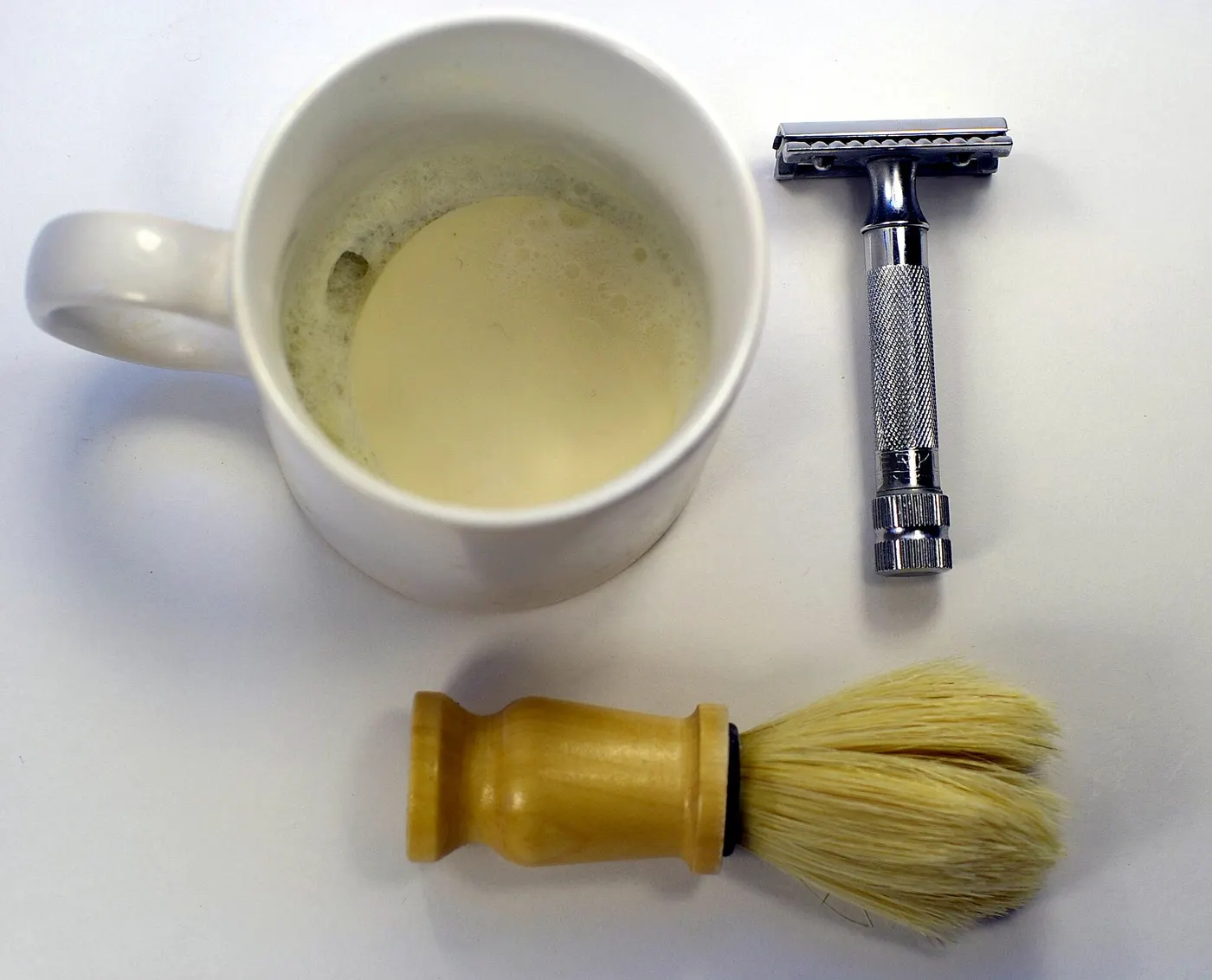
Before changing any product, change the blade. Most irritation blamed on skin is a blade problem: a double-edge blade past about 5 shaves or an electric head past the maker's 18-month replacement schedule stops cutting and starts pulling, and pulling is what produces the red patch along the jaw. Braun's own guidance is to change foil and cutter block every 18 months with good cleaning habits and average frequency, and to change both together.
Second, reduce passes. Two passes with a sharp blade irritates less than four with a dull one, and the third pass over the same skin is where most burn is generated. Third, stop stretching the skin taut: a stretched surface lets the blade cut below the skin line, and the hair then retracts under it, which is the mechanism behind ingrown hairs on the neck.
Fourth, fix the preparation time. Hair is measurably softer after a few minutes of warm water, so a shave taken straight off a cold face is working against a stiffer hair with the same blade. Three minutes of warm water, or shaving at the end of a shower rather than before it, costs nothing and changes the amount of force needed.
| Change | What it addresses | How long before you judge it |
|---|---|---|
| Fresh blade or new head set | Pulling rather than cutting | 1 shave |
| Fewer passes over the same area | Cumulative abrasion | 3 to 5 shaves |
| Stop stretching the skin | Ingrown hairs on the neck | 2 to 3 weeks |
| 3 minutes of warm preparation | Force needed to cut the hair | 2 to 3 shaves |
| Switch to a fragrance-free balm | Possible fragrance sensitivity | 2 weeks |
The order matters: the mechanical changes are free and fast to judge, so they come before any product change, which takes weeks to evaluate and costs money.
Before you buy
- Replace the blade or head set before changing any product
- Reduce to two passes and stop going over the same area a third time
- Stop stretching the skin, especially on the neck
- Allow 3 minutes of warm water before the first pass, or shave at the end of a shower
- Read the first five ingredients and treat the rest as an unordered set
- Choose fragrance-free rather than unscented if a reaction has already happened
- Change one variable at a time and leave 2 weeks before judging it
Questions readers ask
- Does an ingredient near the end of the list matter?
- Only as a yes or no. Below 1%, ingredients may be listed in any order, so position in the back half carries no information about quantity. If you react to a specific substance, its presence anywhere on the list is what counts; if you are comparing concentrations between two products, the label will not settle it.
- Is 'fragrance-free' a regulated term?
- It is a claim about contents rather than a defined approval, and it is the more useful of the two. 'Unscented' can still mean fragrance ingredients are present to mask other smells. The FDA's own advice for people worried about sensitivity is to choose fragrance-free products and read the ingredient list carefully.
- How long should I test a new product?
- Two weeks, changing nothing else. Contact reactions can take several exposures to appear, so a single use proves little, and changing a balm and a blade in the same week makes the result unreadable. Test on the jaw rather than the forearm, since facial skin and shaved skin behave differently.
- Why do ingrown hairs appear mostly on the neck?
- Hair on the neck often grows at a shallower angle and in mixed directions, so a very close cut leaves the tip below the skin surface where it can re-enter the follicle. Stretching the skin makes this worse by letting the blade cut below the surface line, which is why the fix is to stop stretching rather than to shave less closely everywhere.
- Can a product legally claim to treat razor burn?
- That wording describes a therapeutic purpose, which makes it a drug claim rather than a cosmetic one. A cosmetic is intended for cleansing, beautifying, promoting attractiveness or altering appearance; a product intended to treat or prevent a condition is a drug, regardless of what aisle it sits in.
Sources
- FDA — Cosmetics Labeling Guide: descending order of predominance, the 1% rule, fragrance declaration and minimum letter height — checked 2026-11-03
- FDA — Fragrances in cosmetics: why fragrance may be declared as a single word, 'unscented' products, and allergen labelling authority — checked 2026-11-03
- FDA — Authority over cosmetics: no pre-market approval except colour additives, and the cosmetic-versus-drug distinction — checked 2026-11-03
- Braun — replacement shaver heads: change foil and cutter block every 18 months, and change both together — checked 2026-11-03
Some links on this site can earn us a commission. That does not change which product a guide recommends, and it adds nothing to your price. Advertising is not enabled on this site yet. When it is, ads will be labelled and kept visually separate from the guides.